Case Study · Website Development
KovaiBuild Case Study: A Construction Website in Coimbatore
KovaiBuild does civil work, interiors, painting, carpentry, tiling and fabrication across Coimbatore. Good work, steady word of mouth, and nothing on the internet that a stranger could find. This is what we built, and why each decision was made the way it was.
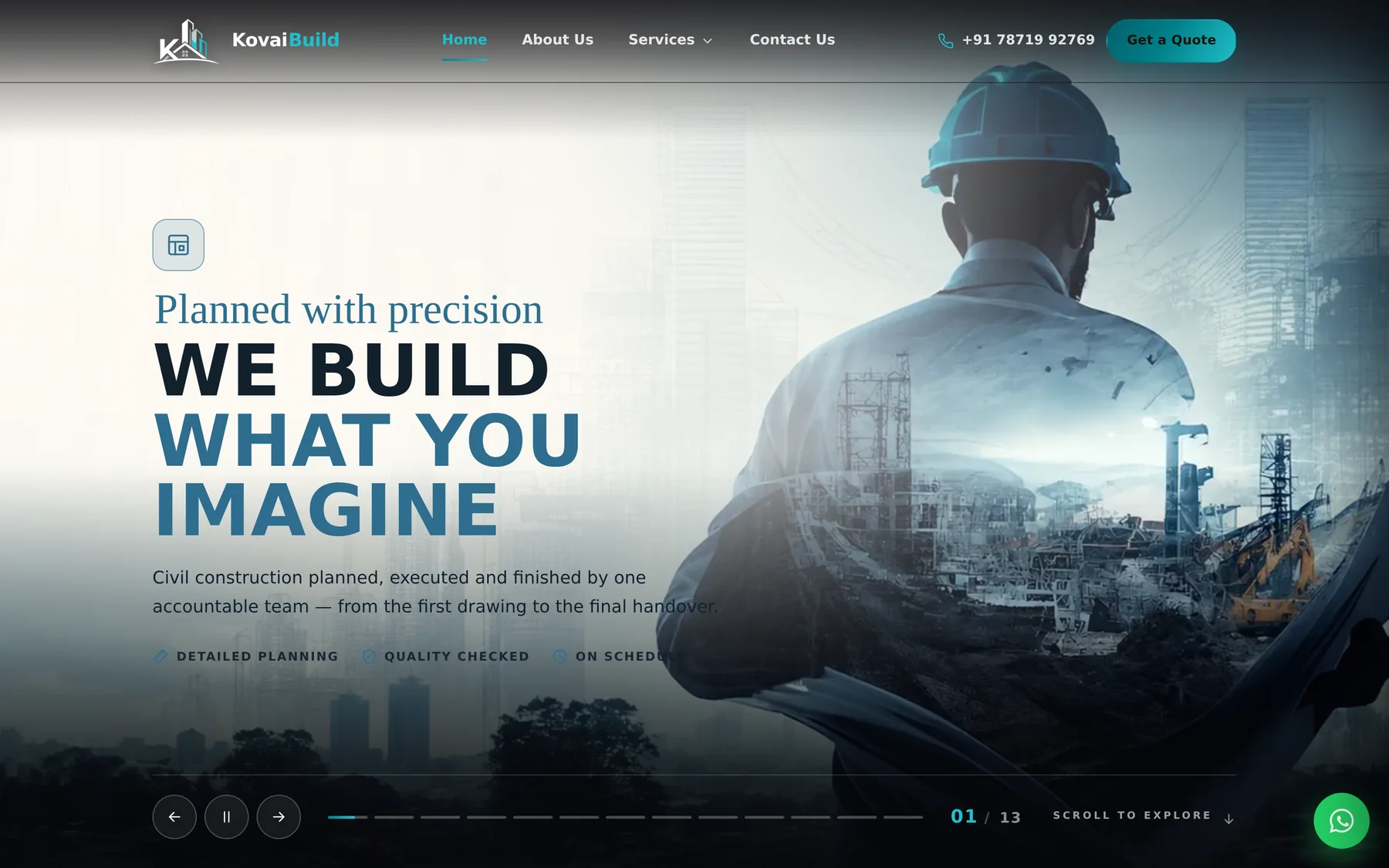
Homepage as delivered. See it live →
| Client | KovaiBuild — construction and home improvement, Coimbatore, Tamil Nadu |
|---|---|
| Scope | Complete website, brand transition, enquiry handling, search and AI visibility groundwork |
| Delivered | Eight pages — home plus seven service pages |
| Built with | Hand-written HTML, CSS and vanilla JavaScript. No framework, no build step. |
| Live at | kovaibuild.in |
The situation
KovaiBuild had two problems that reinforced each other. The first was that the business had no web presence at all — every enquiry arrived through someone who already knew someone. That works until it doesn't, and it puts a hard ceiling on growth.
The second was a rebrand. The company had traded as Silver Star Construction and was moving to KovaiBuild. A rebrand with no website is an awkward moment: the old name carries whatever recognition exists, the new one carries none, and there is nowhere authoritative that states which is which.
What we decided, and why
No framework
A seven-service construction company does not need React. The site is hand-written HTML, CSS and vanilla JavaScript with no build step, which means there is no toolchain to rot, no dependency to patch, and nothing between the server and the visitor. Pages arrive as finished HTML, which matters more than it used to — search crawlers and AI systems read server-rendered text reliably, and JavaScript-dependent content far less so.
It also means the client is not locked in. Any competent developer can open these files in ten years and understand them.
One page per service, not one page listing services
Civil work, painting, carpentry, tiling, fabrication and welding, mosquito net doors and interiors each got a full page rather than a bullet on a services list. Someone searching for a carpenter is not served by a paragraph inside a page about seven other trades — and neither is a search engine trying to work out what the page is about.
An enquiry form that cannot quietly fail
The contact form validates in the browser for convenience and again on the server, where it actually counts. Every submission is emailed and separately written to a log file kept above the web root, so nothing is lost even if mail delivery fails silently — which, as we found on a later project, it sometimes does.
It also carries a honeypot field and a per-IP rate limit, because a public form on a small site attracts bots within days of going live.
WhatsApp as a first-class contact route
In this market, WhatsApp is not an alternative to a phone call — for many customers it is the preferred one. A click-to-chat button sits on every page, so an enquiry costs one tap rather than copying a number into another app.
Built to be read by machines as well as people
The site carries structured data describing the business, its location
and each service; a sitemap; and a robots.txt that
deliberately permits AI crawlers alongside conventional search engines.
There is an llms.txt file summarising the business in plain
language for assistants that look for one.
We were careful about what that last part promises. llms.txt
is a proposed convention, not a ratified standard, and no assistant is
obliged to read it. It costs almost nothing to publish and may help; it
is not a guarantee, and we did not sell it as one.
Verified where it counts
The domain is verified in Google Search Console via DNS and registered in Bing Webmaster Tools, with the sitemap submitted to both. Bing matters more than its search share suggests, because several AI assistants draw on its index.
What this case study does not claim
You will not find percentages on this page. No "leads up 240%", no "first page in six weeks", no traffic graph.
That is deliberate. The site is recent, and we do not have a defensible before-and-after to publish — partly because there was no "before" to measure against. Inventing figures, or quoting real ones without the context that makes them meaningful, is the easiest thing in the world to do and the fastest way to lose the trust of anyone who reads carefully.
What we can show is the work: what was built, why, and how it holds up under inspection. When there are results worth publishing, they will appear here with the method attached.
What was delivered
- Eight pages — home plus Civil, Painting, Carpenter, Tiles, Fabrication & Welding, Mosquito Net Door and Interior work.
- Responsive throughout, built and checked from 320px upward — most visitors arrive on a phone.
- Server-validated enquiry form with email delivery, off-web-root logging, spam honeypot and rate limiting.
- Click-to-chat WhatsApp on every page, plus click-to-call.
- Structured data for the organisation, its location and each service.
- Sitemap, robots.txt and llms.txt, with AI crawlers explicitly permitted.
- Search Console and Bing Webmaster Tools verified, sitemaps submitted.
- Clean brand transition — the previous trading name appears nowhere on the new site.
What we would tell another construction business
Three things carried most of the weight on this project, and none of them is exotic.
Give every service its own page. It is the single highest-return structural decision available to a trades business, and it costs nothing but writing.
Make the enquiry route match how customers actually behave. A contact form alone is a bet that people will fill in a form. Adding WhatsApp and click-to-call costs an hour and removes that bet.
Publish the boring machine-readable files. Structured data, a sitemap, a sane robots.txt. They do nothing dramatic on their own, but their absence quietly caps everything else you do.
Considering something similar?
If you run a trades, construction or services business and your website is either absent or not producing enquiries, we can talk through what would actually help — including when the honest answer is that a website is not your bottleneck.